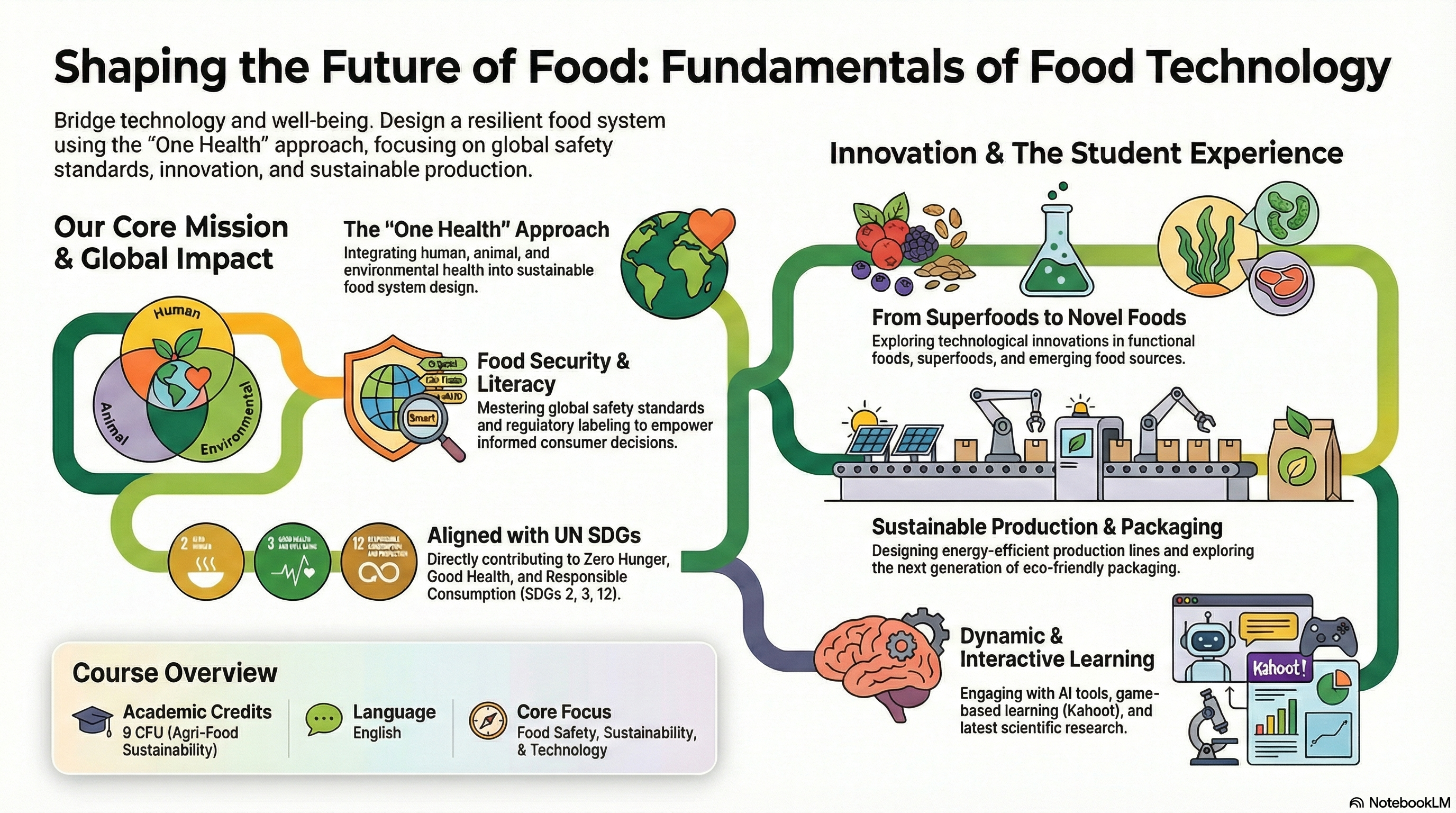
Why this course matters. In contemporary society, the way we produce, transform, distribute, and consume food is inseparable from both human health and the future of our planet. For this reason, the course is built around a set of core pillars.
First, we adopt a One Health perspective, looking at food systems as the interface between human, animal, and environmental health. This holistic lens helps you understand how dietary patterns, agricultural practices, and ecological pressures interact within the same system.
Second, we address food security, food safety, and food literacy, with a specific focus on international standards and food labelling regulations, so that you can critically interpret—and communicate—nutritional information and public health recommendations.
Third, we work on risk mitigation in very practical terms: reducing food waste and contamination, preventing foodborne illnesses, and applying correct handling and hygiene procedures across the food chain.
Finally, we explore sustainability and innovation, covering preservation and processing technologies with particular attention to sustainable packaging and solutions that maintain quality while lowering environmental impact.
A modern and diverse curriculum. The syllabus spans a broad range of current topics, from the triple burden of malnutrition and biodiversity to emerging trends and technologies. You will examine functional foods, superfoods, and novel foods, learn how HACCP principles support food safety by design, and develop a critical approach to sensory evaluation and the scientific basis of health claims. We also discuss how to design production lines that are efficient and energy-sustainable.
An engaging learning experience. Teaching is designed to be interactive and research-informed. Alongside in-person and online lectures, we will use AI-supported tools and up-to-date scientific literature, interactive platforms such as Kahoot, and focused seminars that encourage discussion and participatory learning.
Evaluation and global impact. Assessment is structured to value both knowledge and engagement: mid-term tests to monitor progress, recognition of active participation, and a final written exam with multiple-choice and open-ended questions. Ultimately, the course aligns with the UN 2030 Agenda, contributing in particular to SDG 2 (Zero Hunger), SDG 3 (Good Health and Well-being), and SDG 12 (Responsible Consumption and Production)—preparing you to navigate, and help shape, the rapidly evolving landscape of global food systems.
- Profesor: Ghanya Al-Naqeb
- Profesor: RACHELE DE GIUSEPPE
- Profesor: ROSALIA PALUMBO